

Biking the South Fork of the American River Trail, hunting for meteorites in Coloma, and visiting Sutter’s Mill and Placerville
With the slowly evolving quality of public transportation in the San Francisco Bay Area and beyond, a big question I always have is ‘how far can you go without a car’, either on a day trip or short weekend camping or maybe a little more, with only a bicycle
It is possible now to get to Folsom or Placerville from San Francisco without a car in four hours. This has been described a few years ago in the Bay Guardian and now there’s updates.
You can take Amtrak with a bicycle from Oakland or Richmond BART to Sacramento in under 2 hours on the Capitol Corridor for 37 dollars. From there you have two choices close by in downtown Sacramento. You can take the Folsom 507 train to Folsom which has bike racks on the train (unlike Muni) or there is a commuter bus from Sacramento to Placerville on weekdays, or you can transfer at Folsom and use the Iron Point Connector to travel all the way to Pollock Pines which is at 4000 feet up in the Sierras. All of this is on El Dorado Transit You can also bike along the American River from Sacramento to Folsom. There is a bike trail the whole way
But what I did was take the train to Folsom and biked all the way up to Folsom Lake via Salmon Falls road to the Salmon Falls Bridge. The newly opened South Fork American River Trail which is the heart of gold panning country along that river and where gold was discovered in 1849. This is also the same area where parts of the Sutter’s Mill meteorite exploded and landed
The South Fork of the American River get’s the 1989 Marin Pine Mountain steel frame San Francisco bike messenger trash bike treatment. The same trash bike that was stolen and recovered in South of Market
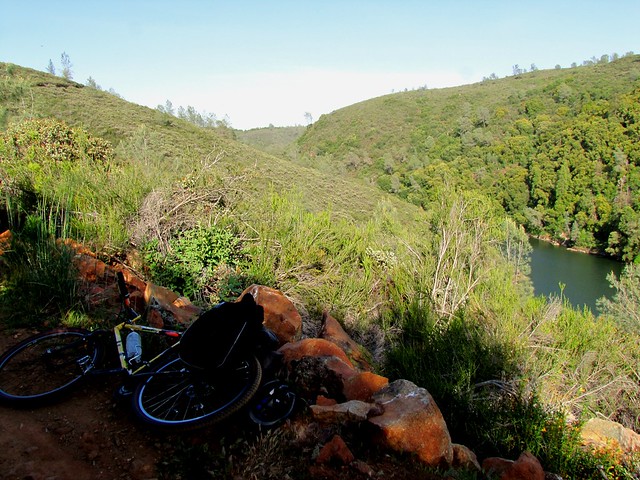

overlooking the Salmon Falls bridge


South Fork American River

abandoned Gold Mining operation from the 1850’s along the American River

On April 22, 2012 a huge fireball from space estimated to be 1/3 the size of the Hiroshima nuclear bomb exploded over this area and rained meteorites over a wide swath of land along the South Fork American river. Maps, charts, Google KML and one of the main forums discussing that now is at radarmeteorites. The fireball and NASA/SETI search in the area is making international news now with two confirmed finds right on the South fork American River along this same trail and in adjacent Cronan Ranch
my own posting on the meteorite forum about this trip
thank you very much, i didn’t really expect it to be meteorites, but i was wondering what the blue stones were…I think the chunky one is actually asphalt, and I saw a lot of that alongside hwy 99
I’ll try this one more time as it got hung up possibly because 2 links were in it, but this is my short trip to Coloma from SF (not just about the rocks)
1 link removed now that the rocks link was posted…
————————–
ok, I finally made the trip from San Francisco to Coloma with a bicycle, on the train and bus to Sacramento then to Folsom and biked up Salmon falls road and then biked up the south Fork American River Trail—with about 50 pounds of gear-haha
it’s all true what they’re saying here…It’s quite hot now in the whole area, and if your from foggy refrigerated SF, you’re not used to that heat–the mosquitoes are relentless, lots of chiggers and snakes, altho I didn’t run across rattlesnakes or scorpions and I had some pretty good DEET
but just so people know, if you’re coming from the coast, it’s getting warm, so bring lots of water because there’s no potable spigots out there on the Amerian River Trail and it’s a good idea to bring filter or iodine tablets if you have to drink the river water like I did…I must have drank about 2 gallons a day of that river water out there
Anyway, only half the reason was to look for meteorites, and the other reason was just to get out of the city for a day or two and finally see a real starry night – i actually saw two satellites zooming across before the moon came up, very cool and worth it just for that
so I biked the river trail which is awesome and saw maybe 5 people in two days, and 3 fellow mountain bikers…I even went to the same sand bar as the SM34 find-but not known to me 2 days ago of the find there as it was posted yesterday
then biked into Cronan Ranch and did the east Ridge trail and Up and Down – heck, it was up and down for 2 days–LOL, and where did all my energy go?…..
exhausted, i finally had enough and biked up to Placerville to take one of the commuter buses back to Sacramento and back to the city – this is one of those rare chances of taking public transit this far out from San Francisco with a bicycle, and I wanted to see how possible it was – with no car
but I did pick up a couple of rocks alongside the road hwy 49 north of between Cronan ranch and Coloma…the problem with the roadside is there is a lot of black asphalt pieces all over so it can look tricky. I don’t think I found any meteorites, but here’s the photos anyway, just in case (btw, I know the blueish one isn’t but what kind of rock is it?)
full flickr photo set. this is NOT a meteorite haha
anyway, i still had a chance to go see the El Dorado Historical Museum in Placerville while waiting for the bus which was also worth it just to see that and here’s the rest of the photos, american river and coloma and placerville
It is true that San Francisco would not exist without Coloma, the American River, Sutters Mill, Placerville and the gold rush, so that’s part of our history, and that made it worth it all by itself…very cool stuff
the meteor just gave me a better reason to finally go see it
One last thing…the entire time, i biked or walked with the bike, i’m looking all around, and at the ground a lot. It occured to me that many of the roads surrounding Coloma would probably be better searched on a bicycle simply because you’re on the side of the road and you’re going slower than a car. Only thing slower than that is walking, and looking at the debris range, well, that’s a lot of walking, and it looks like you can walk for weeks and not cover all the public roads in the debris field area. And that’s the thing, as has been mentioned here before, many of the finds have been near the roads, of in the flats near town because the rest of the country is thick bush, trees, high grass, and it’s the trails and roads is about the only thing clear enough to see beyond a few inches/feet – unless you’re willing to go in with a super weed whacker or something like that, you’ll probably never find it in the bush
what I’m saying that if I had the time to do it again, I’d take my bike and cruise the roads, on the shoulders, nice and slow


This is Coloma, California, ground zero of Sutter’s Mill, the 1849 gold discovery and the Sutter’s Mill Meteorite

This is the park where some of the first meteorites were found

and across the street at the original Sutter’s Mill (for which Sutter street in San Francisco is named after)

These sand bars on the American river still sparkle with tiny bits of gold, too tiny to make a living from tho, but you can still see it

Placerville, old Hangtown, where Hangtown fry was invented


This Hangman’s Tree building was nearly town down by the City of Placerville recently to make way for newer touristy stuff, but was bought by a private interest, which is why there is a fence around it right now

El Dorado Historical Museum in Placerville
San Francisco would not exist without the gold rush here. This is a rare painting of converted whaling ships from back east that were full of crew and passengers, sailed around the South American cape, landed in San Francisco and promptly abandoned in San Francisco harbor in 1850. passengers and crew abandoned at Rincon point leaving a fleet of ghost ships with nobody to run them, because they all went to Placerville and Coloma


The original Pony Express route from Missouri to Placerville which lasted for only 3 years until the telegraph was invented

famous Norwegian Snowshoe Thompson who helped run the pony express


The original native Americans in the area were Miwok People

Gold was 5 dollars an ounce in 1850, but so was a room for the night and bread was a dollar.. Most of the gold panners had to pan 3 ounces of gold a day out of the river just to survive, and most of the people who actually made any money were not the panners, but the people who supplied them and the equipment makers
Studebaker was one of those big names who mad it big in the Gold Rush, not by panning, but by making the equipment that miners used


supplying the gold miners, provisions and equipment
wheelbarrows for haulin

mining and panning and slurry equipment


guns, knives, jars and utensils


scales for weighing the gold

saddles for horses

saws for cutting trees and making roads

steam carts

provisions, food, groceries in 1850


furnishings, shellack records, victorian era clothes


apple press

seed cleaners

laundry and washing gear

stoves, ovens, cooking gear


and last but not least, safes for storing all that gold
