HSH Critical Incident Reports: What Was Required, Reported, Asked and Found
A documentary chronology of San Francisco's Critical Incident Report requirements, public testimony, Controller findings and Civil Grand Jury findings — with particular attention to a basic oversight question: how does HSH know whether a low incident count means fewer incidents, or simply fewer incidents reported?
Related research:HSH maps and graphs ↗ — maps, site data and related visual analysis.
The rules existed
2018
HSH required providers to report specified emergencies
HSH procurement and contract documents required Critical Incident Reports for categories including deaths, serious violence, and emergencies involving police, fire or ambulance response, generally within a stated deadline. Many such events also leave an independently generated public-safety record.
Controller identifies weaknesses in CIR workflow and analysis
The Controller's City Performance team recommended clearer incident-response workflows, improved data collection, recurring reports and periodic trend meetings. The analysis documented differing understandings of CIR responsibilities and the need for more systematic use of the information.
Dorsey tests what the CIR system actually captures
Supervisor Matt Dorsey
Dorsey asks what happens when a permanent-supportive-housing resident suffers an overdose or medical emergency, is transported away from the property, and dies elsewhere: does HSH learn what happened and incorporate it into its understanding of overdoses?
Emily Cohen — HSH
Cohen says this can be a challenge because HSH does not always know immediately what happens after a resident is transported. She says the Critical Incident Report process is “supposed to capture that.”
Emily Cohen — HSH
Cohen also describes HSH staff reviewing overdose CIRs and walking through them with individual providers to “unpack what happened,” identify “patterns and trends” within projects, and determine whether additional resources or technical assistance are needed.
Why it matters: HSH describes CIRs as both an incident-capture mechanism and a project-level pattern-detection tool. A medical transport also creates the possibility of an independent EMS record against which CIR reporting could be checked.
September 17, 2026: the reporting paradox becomes explicit
Government Audit & Oversight Committee — BOS File 260729
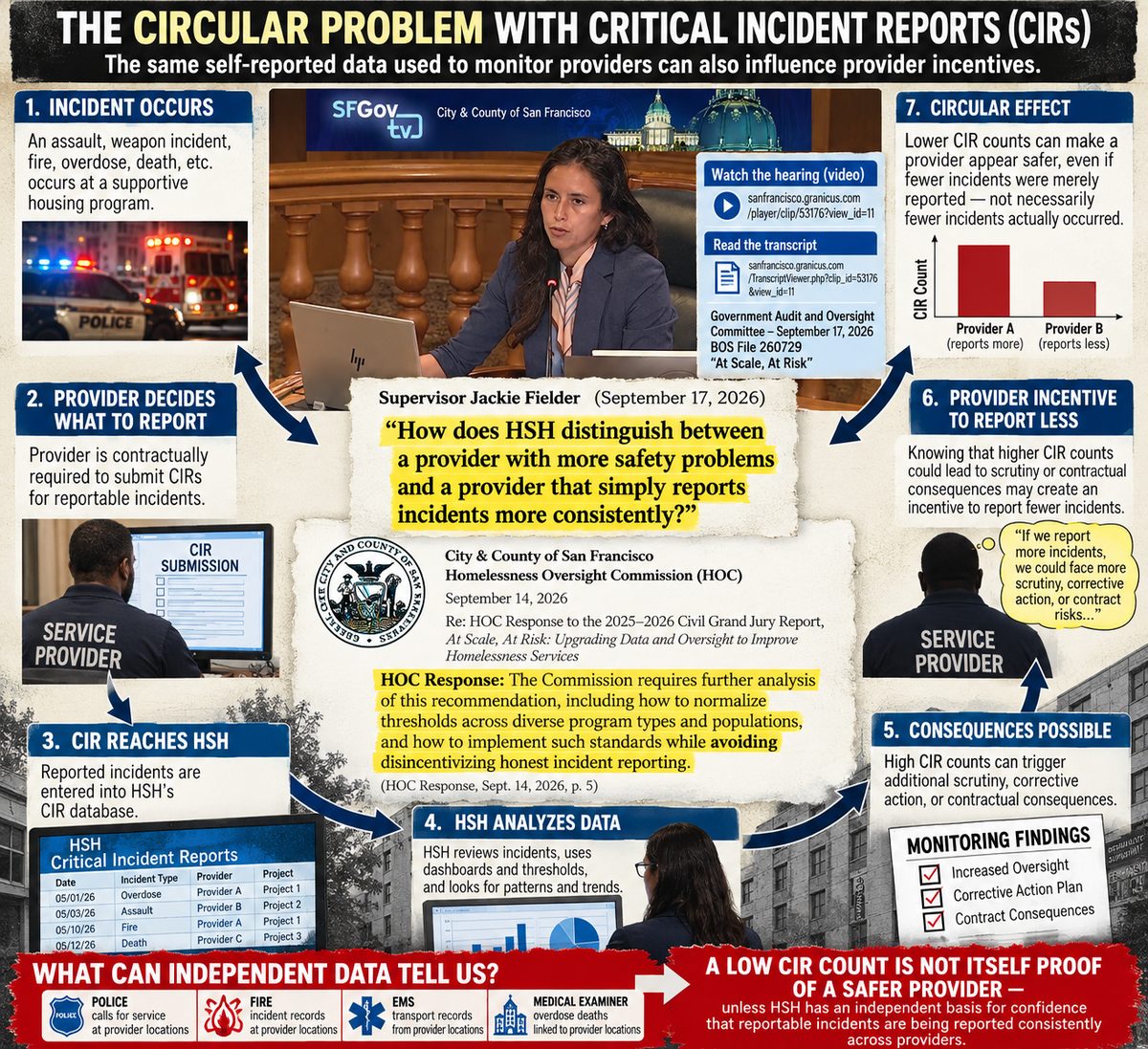
Fielder asks the central measurement question
“How does HSH distinguish between a provider with more safety problems and a provider that simply reports incidents more consistently?”
Supervisor Jackie Fielder
Fielder's question goes to whether CIR totals are actually comparable among providers when reporting behavior itself may differ.
Emily Cohen — HSH
Cohen says HSH does not want to discourage providers from reporting incidents and describes reviewing incidents by provider and by type.
Why it matters: A provider that reports more faithfully can appear to have more safety problems than a provider that underreports. Without some independent check on reporting completeness, a low CIR count is ambiguous.
The circular reporting problem: the same self-reported data used to assess providers may also affect providers' incentives to report.
September 14, 2026
HOC independently recognizes the incentive problem
Responding to the Civil Grand Jury recommendation for contract safety standards based on CIR categories and thresholds, the Homelessness Oversight Commission said further analysis was needed, including how to normalize thresholds across different programs and populations and how to implement such standards while avoiding “disincentivizing honest incident reporting.”
Why it matters: The concern is not hypothetical. The oversight body itself identified the risk that consequences tied to CIR counts could influence reporting behavior.
The unresolved verification question
A low CIR count is not itself proof of a safer provider. It could reflect fewer reportable incidents, fewer incidents being reported, or some combination of the two. Police calls for service, fire incident records, EMS transports and Medical Examiner records can provide independent reference points for testing at least part of the self-reported CIR dataset.
Missing CIRs and unused CIRs are different problems
Missing CIRs: qualifying incidents may never have entered HSH's dataset. This raises questions about provider compliance, clarity of reporting rules and verification.
Unused CIRs: reports that did reach HSH may not have been aggregated and analyzed effectively enough to identify recurring site or provider risks. The Controller recommendations and Civil Grand Jury findings address this problem directly.
An independent check was feasible long before the current debate
June 21, 2008
Address-level police records were already being obtained and compared
A public-records comparison used address-specific police-call information to compare activity at MSC South and the Tenderloin Housing Clinic's Seneca Hotel. The example demonstrates the practical feasibility of obtaining address-level public-safety records years before HSH's modern CIR system.